← Back to AI Watermark Remover
Image metadata & C2PA remover
Strip C2PA content credentials, EXIF, XMP and generator fields from PNG and JPEG without touching a single byte of image data.
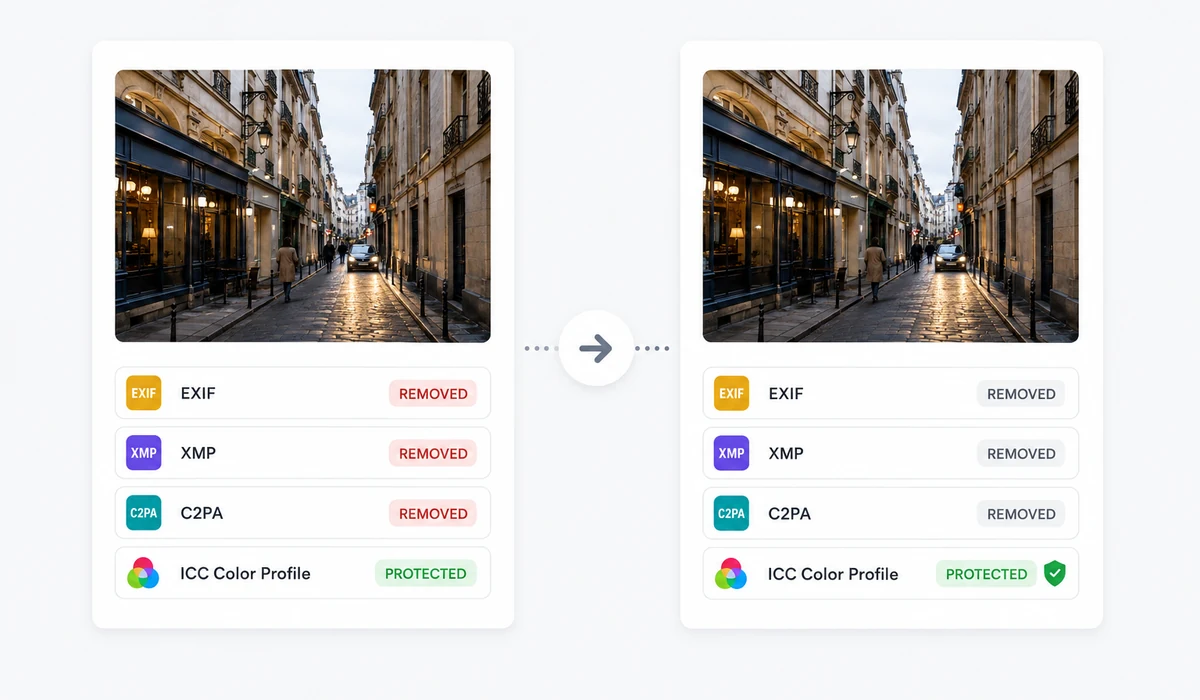
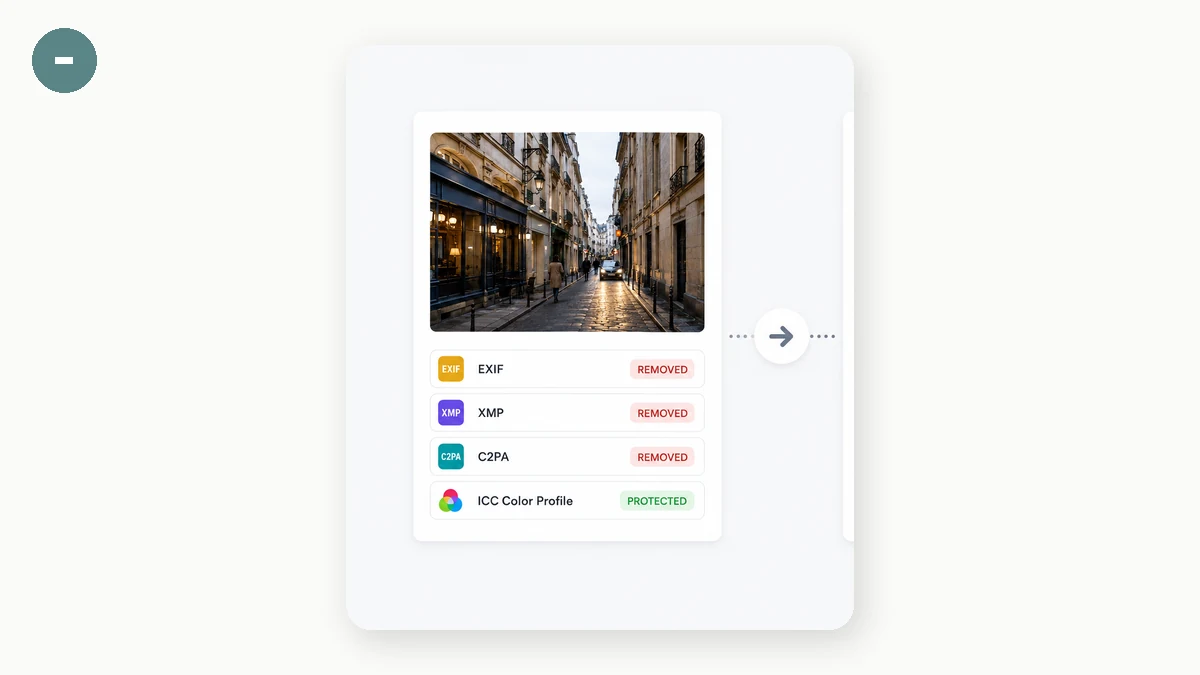
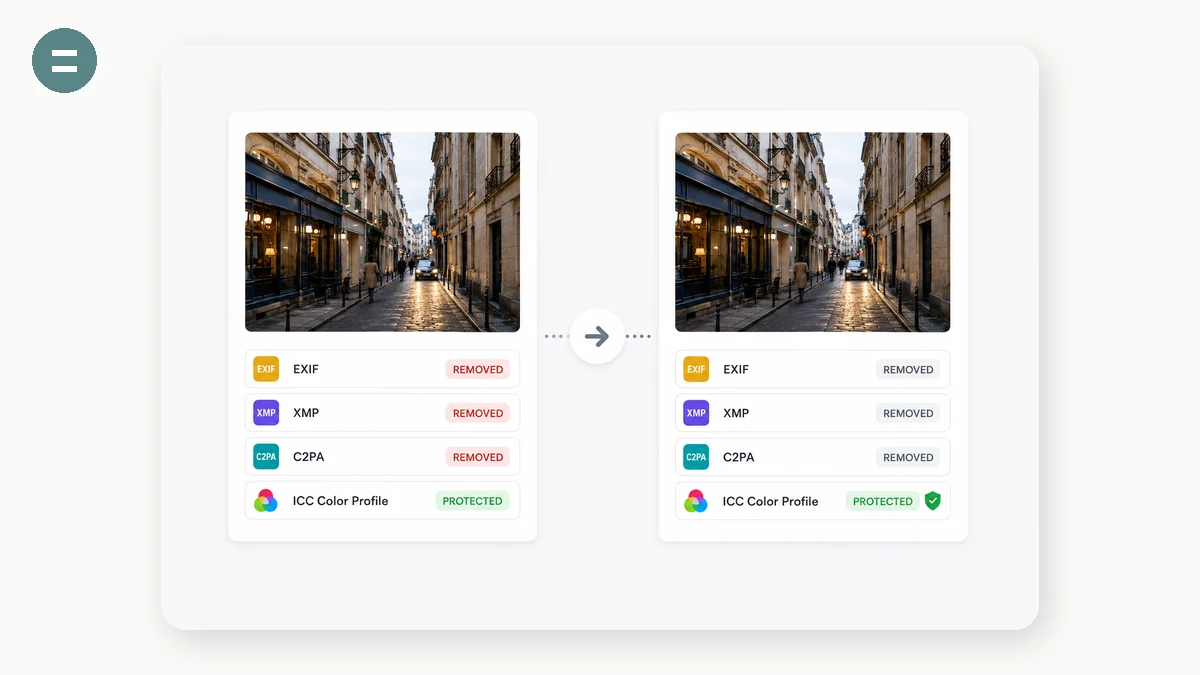
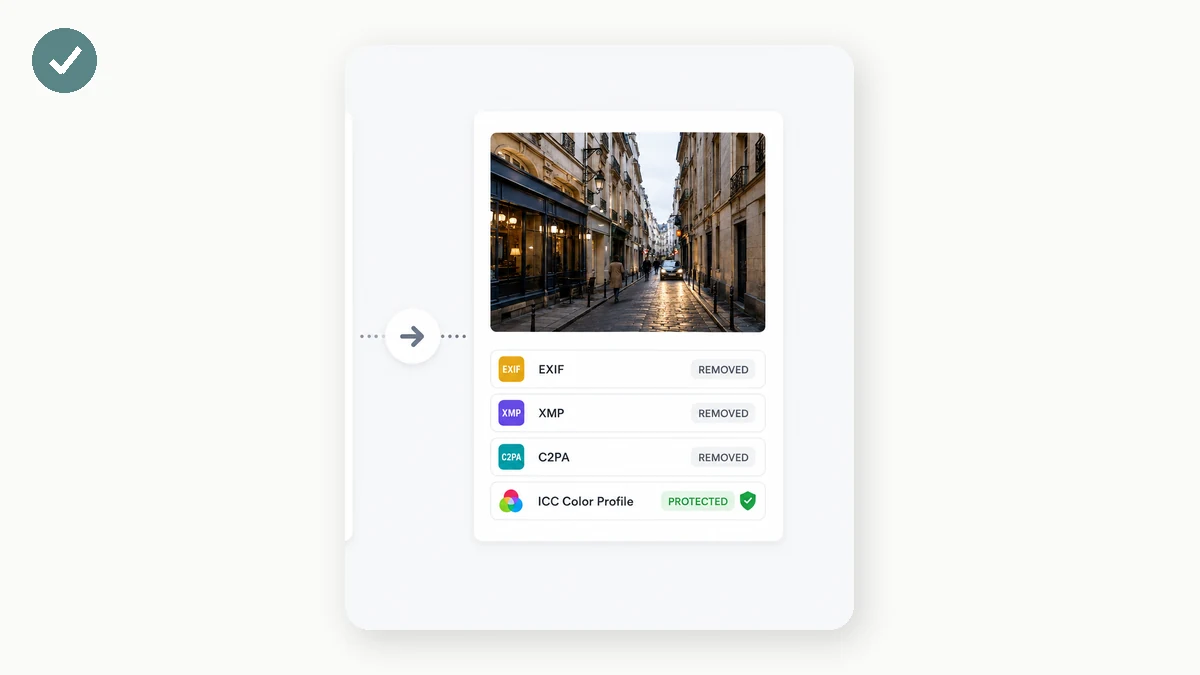
From input to result
Choose a file, process it locally, review the result, and export.
A photo carries more than most people expect: GPS coordinates accurate to a few metres, camera and lens model and sometimes serial number, capture time, editing software, author and copyright fields. AI-generated images often carry C2PA content credentials naming the model and generation time — occasionally the prompt too. All of it lives in the metadata layer, stored separately from the picture you see.
The tool walks the actual file structure. For PNG it iterates chunks and drops eXIf, C2PA containers and text chunks; for JPEG it walks segments and drops APP11 (the usual JUMBF/C2PA container), other APP segments and comments, while keeping the APP0 JFIF header. Image data is copied verbatim — PNG IDAT and the JPEG scan are untouched, so quality is bit-for-bit identical.
One detail worth calling out: the ICC colour profile lives in JPEG's APP2 segment. It describes how colours should be displayed rather than who made the file, and removing it can shift colours on other devices. It is therefore kept by default, though you can strip it too.
How to use
Drop in images
PNG and JPEG, as many at once as you like. Nothing is uploaded.
Read the findings
Each file lists the metadata, C2PA markers and AI traces that were found.
Download the clean copy
One by one, or as a ZIP when there are several. The log shows which chunks were removed.
FAQ
Can it remove a SynthID image watermark?
No. SynthID's image watermark is embedded in the pixels and survives cropping, compression and filtering. It is not in the metadata layer, so no metadata tool can touch it. We handle metadata only, and won't claim otherwise.
Does cleaning reduce quality?
No. Image data is never re-encoded — PNG IDAT chunks and the JPEG scan are copied verbatim and only metadata blocks are dropped. That is fundamentally different from "save again", which would add a second round of lossy compression.
Does removing C2PA make the source untraceable?
The in-file manifest is genuinely gone, but C2PA also supports soft binding, where a service re-links content by fingerprint against its own database. No local tool reaches a record on someone else's server.
Why keep APP0/JFIF?
It is JPEG's basic header, describing decode parameters such as pixel density, and carries no identity information. Removing it can stop older software from opening the file.
What about WebP and HEIC?
Currently PNG and JPEG only, which covers the vast majority of cases. For other formats, convert to PNG or JPEG with the site's converter first — conversion itself does not carry the original metadata across.
Related searches
Other tools
AI text watermark & invisible character remover
Find and strip zero-width characters, tag characters, bidi controls and odd spaces. A visual preview lets you actually see what was invisible.
Document metadata remover
Clear author, company, last-modified-by and editing time from DOCX, ODT and PDF. Worth a pass before sending a CV or a deliverable.
AI watermark detector
Read-only. Lists the metadata, C2PA manifests and AI traces a file actually contains, so you can decide before changing anything.