
The instinct is understandable: free tools feel cheap and suspicious, paid tools feel professional and trustworthy. For image editing, that instinct is often backwards. The price tag tells you almost nothing about how your photos are handled. What matters is where the processing happens and what the business model is — and those don't line up neatly with free versus paid.
Let me lay out the actual trade-offs.
What "free" usually costs you

Free online tools have to pay their server bills somehow. The common ways they do it are worth naming:
- Ads and trackers. The page loads a stack of advertising and analytics scripts that follow you around the web. The tool is a lure; your attention is the product.
- Data. Some free services keep your uploads to train models or build datasets. The terms of service quietly grant them a license to do it.
- Friction toward an upsell. File-size caps, slow queues, aggressive watermarks, and locked features exist to make the free tier annoying enough that you pay.
None of this is automatically evil. Ads keep a lot of useful things alive. But it means "free" is rarely free — you're usually paying with attention, data, or patience.
What "paid" actually buys — and what it doesn't
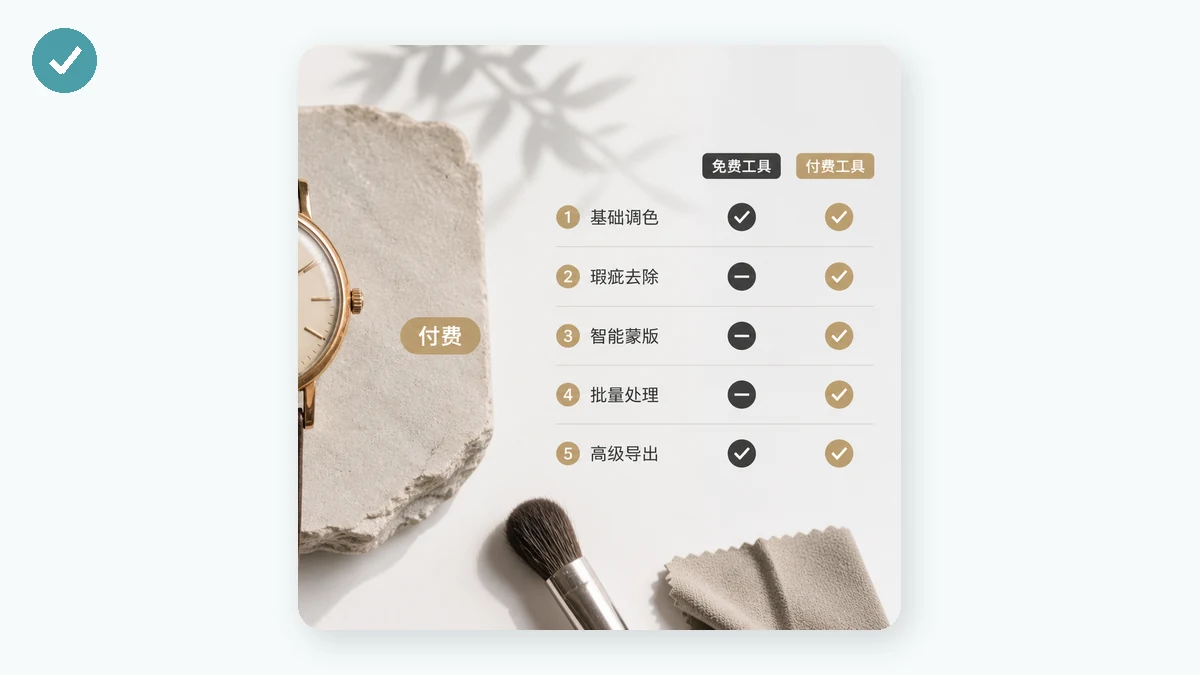
A subscription can buy real things: no ads, higher limits, batch processing, priority support, advanced features. For a professional running hundreds of images a day, that's often money well spent.
Here's the catch: paying does not mean your files stay private. Most paid tools are still server-based. You upload, their servers process, they send a result back — the same data path as the free version, just without ads in front of it. You've removed the annoyance, not the upload. Your images still land on someone else's disk, subject to their retention policy and their terms.
So the honest framing isn't "free = risky, paid = safe." It's: does this tool send my file to a server, free or paid?
The third category: tools that run on your device
There's an option that sidesteps the whole debate. Modern browsers can compress, convert, resize, and even run AI models entirely on your own machine using Canvas and WebAssembly. When the processing happens locally:
- There's no upload, so there's nothing to store, log, or train on.
- There's no server bill to cover with ads or data harvesting.
- There's no file-size cap imposed by someone else's hardware.
That's the model tools.faxianai.com uses. Image Compressor runs in your browser — free, no sign-up, no watermark — and your photo never leaves your device. It's free and private, because the two aren't actually in tension once you remove the server.
Watermarks and the free-tier tax
Watermarks deserve a special mention because they're the most visible "free tax." A tool that stamps its logo across your result is betting you'll pay to remove it. That's a fair business model — but it's not the only one. A browser-based tool has no server costs to recoup per image, so it can hand you a clean, full-resolution result for free without the upsell pressure.
The same goes for background removal, which people often assume must be a paid, cloud-based feature. It can run locally too — after a one-time model download, Background Remover works entirely on your device, even offline, with no watermark and no per-image charge.
How to actually choose
Skip the free-versus-paid framing and ask three questions:
- Where does my file go? Local processing beats any server tool on privacy, free or paid.
- What's the business model? If you can't tell how a free tool makes money, assume it's ads or data.
- Do I genuinely need the paid features? Batch pipelines and pro support are real value — for high-volume work. For everyday compressing, converting, and cleanup, a good browser tool covers it for nothing.
The best outcome is usually the boring one: a free tool that runs on your device, takes no data, and does the job. Paid tools earn their keep at scale — but paying is not the same as being safe.